


A Human Design compatibility chart, also called a connection chart, puts two birth charts side by side and shows what happens in the space between them. It marks the channels that only exist when the two of you are together, the ones you share, and the places where one of you holds something the other lacks.
It is a description in the language of the system, not a score. There is no such thing as a failing grade here, and no pair is labeled incompatible. The chart answers a narrower question: which parts of each design meet, and how.
What the chart counts
Your chart has 26 activations, and so does the other person's. The connection chart pools them. Every gate that appears in either chart is counted, and then each channel is checked to see whether the pooled gates complete it.
Teachers word the four situations slightly differently, particularly compromise. The cards above give the version most often used. Gates you share without completing a channel are not one of the four, though they still show what you have in common.
How to read the chart
- Start with the electromagnetic channels. They are new. They are described as the source of chemistry, and also of friction, because each person feels the lack of the other half when apart.
- Look at dominance and compromise next. These show where one person's definition is steady and the other's is open. The system says the open person is more shaped by the other there, and it suggests noticing which of those themes you are comfortable receiving.
- Check companionship. A channel you both have is comfortable, but it also makes a shared blind spot: neither of you brings anything new to that theme. The same goes for a gate you both carry when nobody holds its partner, so nothing in the pair supplies the missing half.
- Read the composite. See which centers are defined once all gates are pooled, and which remain open in both charts.
The composite chart
In the composite, two people can define centers that neither defines alone. An electromagnetic channel can complete a link between two centers, and a pair of Projectors with open sacrals may end up with a defined sacral together. Teachers sometimes read the combined type as the character of the relationship, and your result shows it as the composite type, with the definition and the centers you define together. Others look only at the new channels, and the method is a matter of taste more than rule.
The centers left open in both charts are worth a look. If both of you are open in the solar plexus, nothing in the pair supplies a steady emotional rhythm, and the system suggests that you borrow each other's moods. If both are open in the root, the pair may feel hurried by outside deadlines. A center defined in only one of you gives that person the lead there.
A small example
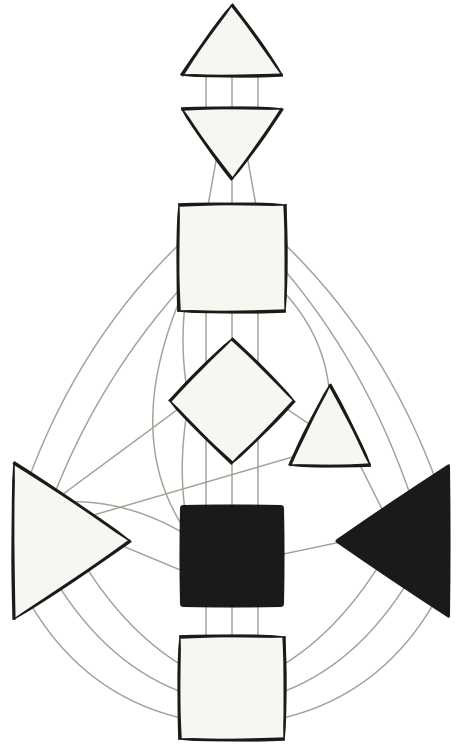
Suppose one person has a defined sacral and an open solar plexus, and the other has a defined solar plexus and an open sacral. Alone, each is missing a center the other holds. Together, the composite defines both, so the pair has a sacral and an emotional wave between them. The system would say the first person supplies steady energy and the second supplies the emotional rhythm. It would also say each should avoid expecting the other to behave like the missing half, since a borrowed center is not their own.
Common misreadings
- More electromagnetic channels does not mean a better match. It means more intensity.
- Dominance is not a flaw. It describes who carries a consistent theme.
- Companionship is not boring. It describes ease, and the system treats ease as valuable in a friendship or partnership.
- The chart works for any pair. Friends, siblings, parents and children, and co-workers can all be compared, and the categories apply in the same way.
Limits and honest framing
Human Design is a belief system. No research shows that the connection types predict whether a relationship is happy, or that the composite describes the shared life of two people. Treat the chart as a way to start a conversation about how you each operate.
The calculation uses both birth moments, so each time and place should be as accurate as you can make them. Please enter another person's birth details only with their agreement. How we handle the details is described on the privacy page, and the method page explains how each chart is calculated. If the terms are new, the guide to reading your chart explains gates, channels and centers, and the centers overview covers the nine centers. You can make your own chart first with the TwoInks calculator.