The Five Human Design Types
In Human Design, every chart belongs to one of five types. The type is the broadest label in the chart, and it comes with a strategy: a rule of thumb for how to approach choices.
Five ways of working
All five
The five types at a glance
The percentages below are rounded figures commonly quoted in Human Design teaching. Jovian Archive publishes statistics from calculated charts, but those records are not a representative population survey. Read these shares as rough context rather than exact population counts. Source checked 3 November 2026.
 About 8 to 9% of people
Manifestor
You are here to start things, and it works when you tell people before you act.
- What to do (strategy)
- Inform
- When it works (signature)
- Peace
- When it's off (not-self)
- Anger
- Aura
- Closed and repelling
 About 37% of people
Generator
You are here to build and keep things going, and it works when you respond to what life puts in front of you.
- What to do (strategy)
- Respond
- When it works (signature)
- Satisfaction
- When it's off (not-self)
- Frustration
- Aura
- Open and enveloping
 About 33% of people
Manifesting Generator
You are here to do many things at speed, and it works when you respond first and then say what you are about to do.
- What to do (strategy)
- Respond, then inform
- When it works (signature)
- Satisfaction
- When it's off (not-self)
- Frustration, often with anger
- Aura
- Open and enveloping
 About 20% of people
Projector
You are here to guide others, and it works when you are asked.
- What to do (strategy)
- Wait for the invitation
- When it works (signature)
- Success
- When it's off (not-self)
- Bitterness
- Aura
- Focused
 About 1% of people
Reflector
You are here to mirror the health of the places and people around you, and it works when you give big decisions time.
- What to do (strategy)
- Wait a lunar cycle
- When it works (signature)
- Surprise
- When it's off (not-self)
- Disappointment
- Aura
- Sampling
How to find your type on a chart
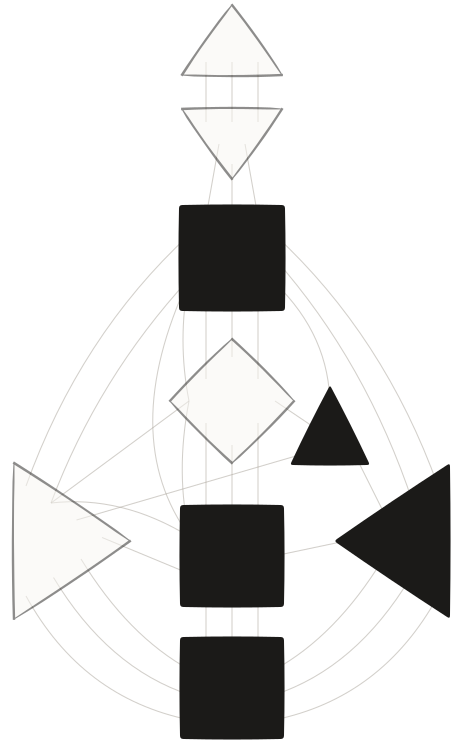
Two questions decide it. First, is the sacral center defined? Second, is a motor center (sacral, heart, solar plexus or root) joined to the throat through an unbroken chain of channels?
- Sacral defined, no motor joined to the throat: Generator.
- Sacral defined, motor joined to the throat: Manifesting Generator.
- Sacral open, motor joined to the throat: Manifestor.
- Sacral open, no motor joined to the throat, at least one center defined: Projector.
- No center defined at all: Reflector.
TwoInks does this check for you when you calculate your chart. To learn the check yourself, the guide to reading your chart shows it step by step with the centers labeled.
What the five strategies share
Four of the five strategies start with something outside you. A Generator waits for something to respond to, a Projector for an invitation, a Reflector for a month to pass. A Manifesting Generator starts with a response too. The Manifestor is the only type told to start things, and its instruction is to tell others first.
The signature and the not-self theme are two ends of one scale. In the system, the signature is what you feel when you follow strategy and authority, and the not-self theme is the warning light when you do not. Many people use the not-self theme as a quick check: if you are often bitter or frustrated, the system suggests looking at where you acted without the strategy.
Type is only the outline
The type gives the broad approach. Your authority says how to make the actual decision, your profile describes the roles you play, and your centers show which parts of you are consistent and which are open to others. Two Generators can feel quite different because their authorities and profiles differ.
Each type has a limited set of authorities. Generators and Manifesting Generators have emotional or sacral. Manifestors have emotional, splenic or ego. Projectors can have any of five, and Reflectors always have lunar.
Mix-ups to avoid
- A Manifestor is not someone who manifests wishes. The word names a wiring pattern and has no link to the law of attraction.
- A Projector is not passive. The strategy is about timing for major choices, not about doing nothing.
- A Manifesting Generator is not half of two types. The chart has a feature of each, and the system treats it as its own type.
If a result surprises you, check the birth time first. The method page explains why a few hours can matter, especially for Reflectors. Human Design is a belief system, and these descriptions are claims within it, not findings.
Questions
Updated
How many types are there in Human Design?
Five: Generator, Manifesting Generator, Projector, Manifestor and Reflector. Some teachers count four by treating the Manifesting Generator as a variant of the Generator, but charts and calculators list five.
Which Human Design type is the most common?
The Generator, at roughly 37 percent of people in community figures. Manifesting Generators come close behind, so about seven people in ten have a defined sacral. These shares are quoted estimates, not survey results.
Which Human Design type is the rarest?
The Reflector, quoted at about 1 percent of people. It is the only type with no defined centers at all, which is why so few birth charts qualify, and why its result is the most sensitive to birth time.
Can your Human Design type change?
Not in the system. The type is fixed by the birth moment and the design moment. A different result usually means a different birth time or place was entered, so check those first.
Is a Human Design type like an MBTI type?
No. A questionnaire result comes from your answers. A Human Design type is calculated from birth data alone, and unlike established personality models it has no research validating it.